
For centuries, handwritten books—manuscripts—have been woven into the fabric of everyday life in Ethiopia. They are clues, documenting what people over thousands of years thought important enough to share. It is incredible what these voices from the past and present have to tell and teach us. These books are living objects written in Ge’ez or Arabic—they are handled in homes, carried into churches and mosques, consulted in moments of ritual and reflection.
But I cannot read Ge’ez or Arabic. How can I learn from these books?
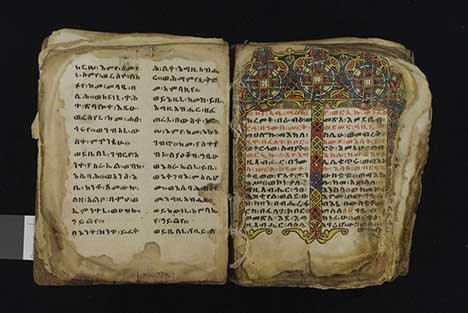
When we look at a book more closely, each detail reveals a layer of human intention: who made this book, how it was or is it being used, and by whom?
We can make connections across languages, cultures, and customs if we do not forget how much knowledge exists beyond language.
What struck me most was the intimacy of the experience. To see these manuscripts up close—objects that have survived centuries of use, travel, and vulnerability—is to feel a kind of quiet connection across time. They are the products of individual hands and communities of faith. They carry memory not just in their texts, but in their very materiality.
The features of some Ethiopic manuscripts reminded me that they are visual, personal, and individual. A mirror on the inside, back cover of the book can be both a reflection of the divine and a practical tool to ensure one’s headscarf is on correctly. A fabric covering a painting of the Virgin Mary is a devotional practice and keeps the painting from getting damaged. A repair stitched into a binding can speak of care and continuity through decades of use and community.
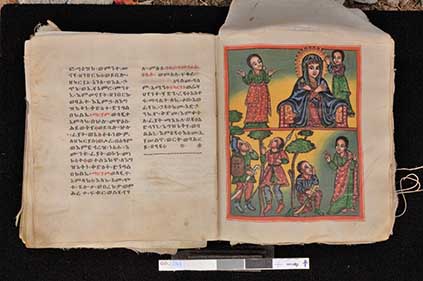
This is not unique to Ethiopic manuscripts and books. Many people, including myself, have objects in our lives that have a high personal, sentimental, or sacred value. Items we believe should be saved and kept. These shared values across time and place help connect all of us as humans.
And yet, this also raised a pressing question: what does it mean, as a global community, to preserve something so personal, so deeply human, in a world that often feels unstable?
For 60 years, HMML has partnered with repositories around the world to photograph and preserve at-risk manuscripts, building partnerships across continents and cultures. The stakes of this work have only grown in recent decades.
Preservation begins through partnerships with local libraries—agreements that allow HMML to make digital images of the manuscripts in their collections.
Digitization is done entirely through local teams to whom we provide equipment, training, technical support, and payment for their work. Copies of the digital images are given to the repository that holds the manuscripts. Another copy comes to HMML in Collegeville, Minnesota.
HMML employs catalogers and other staff to ensure that the digital images of these manuscripts are identified, supported for long-term access, and are made freely available to the public via our website.
The workshop with Dr. Brown invited us to slow down and look, showing us that even without shared language, we can appreciate and learn from these objects. You can extend this dialogue at HMML’s 60th celebration on May 16 at Westminster Presbyterian Church in Minneapolis. The morning begins with Museum without Glass, an invitation to engage directly with rare materials—turning pages, examining details, experiencing history without barriers. It is a continuation of the same spirit cultivated in the workshop: that understanding begins with attention, and that closeness can transform curiosity into care.
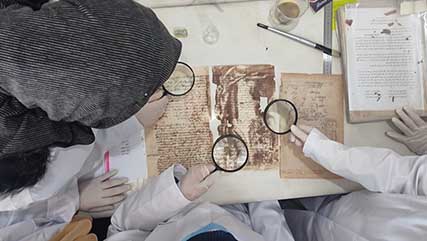
From there, HMML’s executive director, Columba Stewart’s talk, Across Borders and Centuries: Protecting Humanity’s Written Heritage, broadens the lens. If the workshop taught us how to see manuscripts, this lecture asks us to consider their future.
Preservation is not only about safeguarding the past; it is about enabling future understanding. These manuscripts—whether in Ethiopia, Iraq, India, or Ukraine—offer insights into how communities have navigated belief, conflict, and coexistence. They remind us that cultural heritage is not static. It is a living dialogue.
Perhaps that is the most enduring takeaway: manuscripts ask something of us. They ask us to look more closely, to listen more carefully, and to recognize the threads that bind us across time and place. In doing so, they offer not just a window into the past, but a guide for the future.
And maybe that is why, even in silence, they speak so clearly.
Thank you for visiting the Minnesota Humanities Center (MHC) blog.
Any views or opinions represented in this blog are personal and belong solely to the blog author and do not represent those of MHC, its staff, or any partner or affiliated organization, unless explicitly stated.
All content provided on this blog is for informational purposes only. The owner of this blog makes no representations as to the accuracy or completeness of any information on this site or found by following any link on this site. Omissions, errors, or mistakes are entirely unintentional.
MHC reserves the right to change, update, or remove content on this blog at any time

By: Audrey Thorstad
Audrey Thorstad is the Director of Programming, Hill Museum & Manuscript Library.