
On Indigenous Peoples Day 2019, a friend snapped a photo of me with tight braids, my grandmother’s shawl, and dentalium earrings by the late Oglala artist Dana Lone Hill. Five years after this photo was taken, I began my young reader’s history of Marie Louise Bottineau Baldwin by examining a strikingly similar photo – one she submitted as her White House employee personnel photo in 1911.
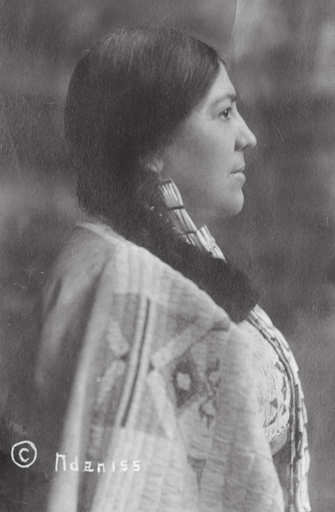
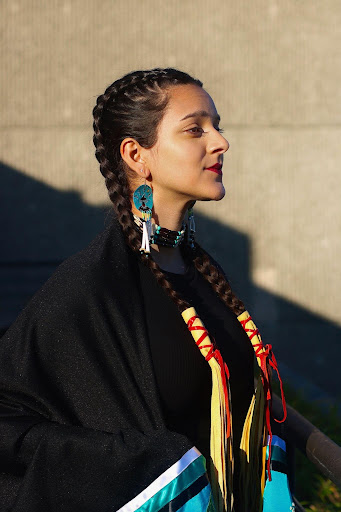
”In the photo, Bottineau Baldwin is posed to show off her beautiful beadwork. Her chin is lifted like she wanted the world to know she was a modern, professional, proud Métis Ojibwe woman who would always represent her people.”
Marie Louise Bottineau Baldwin: Political Pathfinder – Page 32
In some ways, my own story parallels Marie’s. Two women, born in deep biboon (“winter”in Anishinaabe), who journeyed from a rural North Dakotan childhood, to young adulthood in the Twin Cities, to the fast paced array of odd jobs on the East Coast all in the pursuit of education. When examining our photos side by side, I pictured what it would have been like to work with Marie at her desk job, balancing the responsibilities of a federal government employee and member of what was considered a conquered nation. At the height of her career, she was not even granted US citizenship. I think about the context of her activism during a time when living memory included the same government bent on exterminating Native people.
Marie Louise Bottineau Baldwin. A French and Anishinaabe kwe (woman) who loved fancy European hats. A woman who also collected, created, and shared traditional Native American artworks throughout her life. An activist – a suffragist – who worked within, for, and against, the United States government throughout her career. Bottineau Baldwin became the highest paid Native American woman in her first year of employment at the White House and one of the first Native American female lawyers in the country at the age of 52. Marie strove to be welcoming and supportive as she understood what it felt like to be barred from professional spaces across her career. She was known to visiting dignitaries and newly relocated Natives in Washington, DC as the “mother to all Indians.”
What was it like to wander the streets of Washington, DC on one of Marie’s tours as she welcomed Native visitors to her urban Indian DC community? Much of her history is obscured. I wonder what style of beading she preferred, and did she crave the Midwestern cold during her DC winters? I wonder if she felt a longing to pursue cultural traditions while working days in the White House and longer evenings in the Washington College of Law libraries. How did she manage the frustration of being relegated to the women’s gallery of the Congressional hearings even though she was the very person who had collected the testimonies on display? Above all, I wonder what it was to hear Marie talk about her life, rather than piecing her experiences together through photographs, letters, federal records, and the works of academics who never knew her.
What would Marie think if she knew that, in one modern Minneapolis afternoon, she could grab coffee at a Native-owned cafe called Powwow Grounds, visit an exhibit dedicated to Native art at the Walker, and watch a live production of Brenda Child’s “Bowwow Powwow” kids’ book brought to life by Mni Giizhik Theatre, a local Native-owned theatre company? Minneapolis is the great Native American metro – blooming with culture, fusion, and a community of Native advocates who get it done. I believe Marie would be cognizant that in this same city, Native people disproportionately suffer homelessness, addiction, and extreme poverty. And though much of her community-building centered in DC, our great Native American metros would not be possible without determined, politically-engaged women like Marie who planted the seeds for a movement of sovereignty and reclamation.
In my admiration of Marie Louise Bottineau Baldwin, I also remind myself that many truths can be true in one moment. In her strategic resolve to fight for the rights of Native people and especially Native American women, Marie overlooked solidarity with other communities. Despite holding a leadership position in the Society of American Indians, an organization directly inspired by the NAACP, Marie missed opportunities to ally with Black communities. Reconciling with Marie’s segregationist and assimilative perspectives reminds me to understand all sides of our heroes in history. We must both contribute to and grow from their legacies. Though Marie was a brilliant activist for Native people, she still internalized conventional beliefs that at times aligned with the same people she fought against. Our greatest heroes are imperfect products of sheer grit. It is important for young readers to be exposed to stories that present these figures holistically and contextually.
During our book launch at the Birchbark Bizhiw, audience members had the chance to study the above photos of myself and Marie. Educator Allison Waukau encouraged participants to challenge their first impressions as they learned about our similar paths and our photos, taken over 100 years apart. Through audience engagement, we were honored to learn that several descendents of the Bottineau family were in attendance! Another Bottineau descendant reached out on Facebook to share their appreciation for the first book to tell the story of Marie Louise Bottineau Baldwin: Political Pathfinder. Native people are not a forgotten people of the past. Indigenous histories deserve contemporary light, and all students deserve opportunities to explore the many significant Indigenous changemakers that shaped this country.
Marie’s story represents the importance of humility – Dbaadendiziwin in Anishinaabe. She was born at the beginning of the allotment of reservations and she lived through each era of Federally Indian Policy after Removal, paving the way for Native Self-Determination. Marie trusted that she could use her position within the government to make a positive impact for Tribal people across the nation as she made choices about the survival of a people who had been on the brink of extinction. She was a determined, intelligent, and adaptable changemaker. I believe she would have grown in her belief system if she were alive today. Humility is realizing you are a product of influences and taking the time to re-examining those influences. It is also about finding balance within yourself and all living things to uphold the power of love. Marie’s story is a reminder that humility is a life long journey that asks us to open our hearts and minds to the voices we might be missing.
Thank you for visiting the Minnesota Humanities Center (MHC) blog.
Any views or opinions represented in this blog are personal and belong solely to the blog author and do not represent those of MHC, its staff, or any partner or affiliated organization, unless explicitly stated.
All content provided on this blog is for informational purposes only. The owner of this blog makes no representations as to the accuracy or completeness of any information on this site or found by following any link on this site. Omissions, errors, or mistakes are entirely unintentional.
MHC reserves the right to change, update, or remove content on this blog at any time

By: Hema Patel
Hema Liesel Erdrich Patel is a writer, artist, dog lover, and lifelong student. She comes from a beautiful blend of cultures – on her mother’s side, mixed German and Turtle Mountain Ojibwe, and on her father’s side, Gujarati Indian. She was raised in both Belcourt, ND and Sisseton, SD, and has called Minneapolis, Minnesota home for most of her years. She is a recent graduate from Yale University with a BA in the History of Science, Health and Medicine and an Education Studies Certificate. Her most recent artistic adventure consisted of a three month bharatanatyam intensive in Ahmedabad, Gujarat, India. Outside of her writing, she is pursuing a path towards medicine as a future pediatrician!