
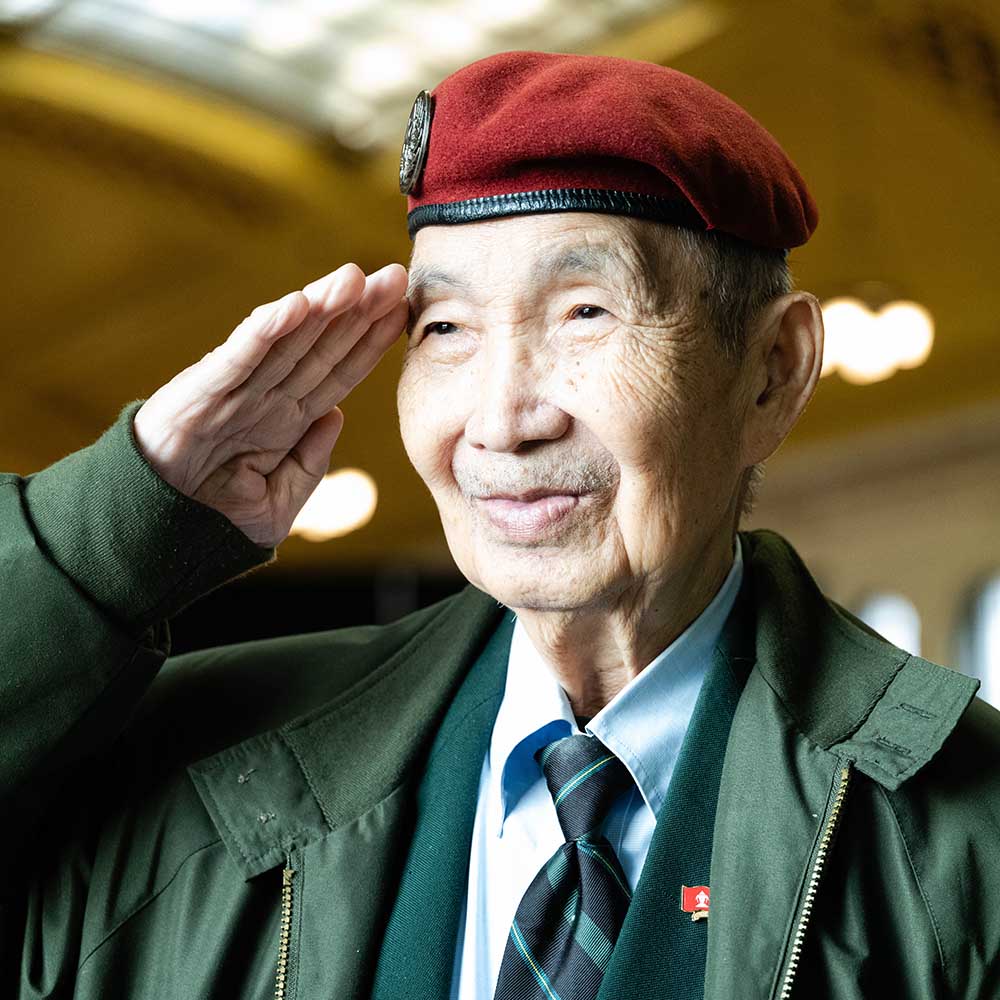
This September, the Minnesota Humanities Center joins family, friends, fellow Veterans, and members of Minnesota’s Lao community in celebrating the 82nd birthday of Colonel Khao Insixiengmay – a Veteran, community leader, advocate, and longtime champion for ensuring that the stories and sacrifices of Lao Veterans are remembered.
For MHC, the occasion is also an opportunity to celebrate a remarkable Minnesotan whose life demonstrates the power of memory and storytelling to connect generations and preserve histories that might otherwise be lost.
Colonel Khao’s story spans continents and decades. Born and raised in Savannakhet in southern Laos, he entered the Lao Army as a cadet in 1961 and was commissioned as a second lieutenant the following year. His military education eventually brought him to the United States, where he studied at Lackland Air Force Base in Texas and the U.S. Army Armor School at Fort Knox, Kentucky.
Beginning in 1968, Khao served with military units in Laos that were funded, trained, equipped, and directed by U.S. officials.
His responsibilities grew from interpreting, training, intelligence collection, and coordinating operations to commanding troops. By 1972, he had risen to the rank of major in the Lao Army and colonel in the Special Guerrilla Unit, with responsibility for four battalions as well as heavy-weapons and security companies.
His service came at tremendous personal cost.
Following the Communist takeover of Laos in 1975, Khao was arrested and sent to a so-called “reeducation” labor camp. His wife and six children were also interned during the years that followed. His autobiography recounts years of forced labor, separation from his family, physical hardship, and uncertainty about whether he would ever return home. He was finally released in 1987.
In 1990, Khao arrived in the United States and began another chapter of service – this time focused on strengthening community.
He eventually joined the Lao Advancement Organization of America, where he worked for 18 years. The organization supported education, employment and economic opportunity while working to preserve Lao culture and traditions and strengthen connections between Lao families and the broader community. Under this community leadership, programs supported hundreds of young people, expanded educational opportunities, promoted Lao traditional dance, and contributed to the establishment of the first Lao Cultural Center of America.
Retirement did not end his advocacy.
Khao went on to establish the United Royal Lao Armed Forces & Special Guerrilla Units Veterans of the Vietnam War, advocating for recognition and support for Lao veterans who served alongside U.S. efforts during the war. His work has taken him across the country and to Washington, D.C., as he has sought greater recognition for those veterans and their service.
A Connection to the Minnesota Humanities Center
Colonel Khao’s story also holds a special place in the history of the Minnesota Humanities Center.
On September 11, 2015, MHC honored him with a Veterans’ Voices Award. In his autobiography, Khao recalls that recognition alongside his work to establish the Lao Veterans Memorial at Fort Snelling – a memorial intended to help ensure that the service of Lao Veterans would not be forgotten.
That commitment to remembrance has remained central to his life.
Khao describes two enduring ambitions: educating the public and younger Lao generations about the sacrifices made by Lao Veterans during the U.S. Secret War in Laos and ensuring that the tens of thousands of Lao fighters who lost their lives are honored and remembered.
Those aspirations resonate deeply with the work of the humanities.
History lives not only in textbooks, archives, and monuments, but in the memories people carry and the stories they choose to pass forward. When those stories are shared, they help families understand where they came from, communities see themselves within a larger history, and future generations encounter experiences they did not live themselves.
Colonel Khao has spent much of his life doing exactly that work.
He has carried forward memories of military service and sacrifice, the experience of displacement and resettlement, and the contributions of Lao Americans to Minnesota. Just as importantly, he has worked to make those stories available to younger generations.
His own autobiography begins by explaining why he wanted to tell his story: to share his experiences, preserve the memory of those who served and sacrificed, educate younger Lao generations, and encourage greater civic engagement and visibility for the Lao community.
At 82, that commitment to memory, community, and the next generation may be among Colonel Khao’s most enduring legacies.
As his family, fellow Veterans, and community gather on September 6 to celebrate his 82nd birthday, the Minnesota Humanities Center is proud to add our voice to theirs.
Happy birthday, Colonel Khao. Thank you for sharing your story, for carrying the stories of those who served alongside you, and for helping ensure that future generations will remember.
Thank you for visiting the Minnesota Humanities Center (MHC) blog.
Any views or opinions represented in this blog are personal and belong solely to the blog author and do not represent those of MHC, its staff, or any partner or affiliated organization, unless explicitly stated.
All content provided on this blog is for informational purposes only. The owner of this blog makes no representations as to the accuracy or completeness of any information on this site or found by following any link on this site. Omissions, errors, or mistakes are entirely unintentional.
MHC reserves the right to change, update, or remove content on this blog at any time

By: Casey DeMarais
Casey DeMarais is the Director of Public Programming at the Minnesota Humanities Center.