
- This event has passed.
Online – Content Session – World History Era One: Early Human History (250,000 BCE-2,000 BCE)
October 1 @ 4:00 pm - 5:30 pm CDT
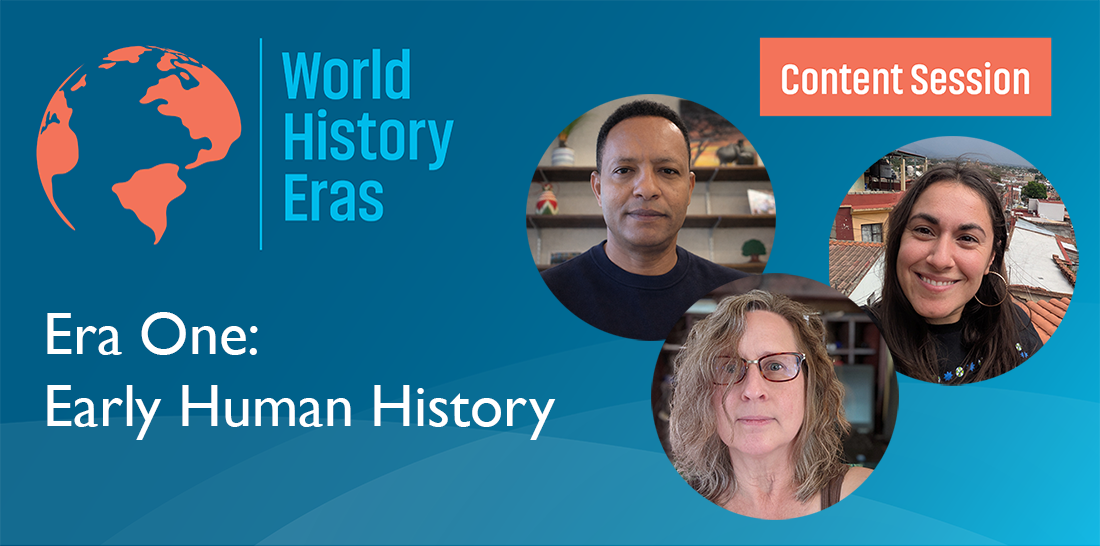
Investigate the origins of humanity through the evidence early people left behind, exploring how historians, archaeologists, and scientists reconstruct the earliest chapters of human history. Dr. Katharine Gerbner, historian and scholarly lead for this series, will facilitate a conversation with historians Katherine (Kat) Hayes, Sofía Pacheco-Forés, and Bula Wayessa. Each historian will present their scholarship, drawing on primary and secondary sources to explore how environment, migration, and material evidence shape our understanding of the ancient world. This session provides deep historical context, source analysis, and thematic framing for teaching this era, with opportunities for participant questions and discussion.
Katherine (Kat) Hayes is Professor of Anthropology and Director of the Heritage Studies and Public History program at the University of Minnesota Twin Cities. She is trained as an archaeologist and received her PhD in Anthropology from the University of California Berkeley. Her earlier work explored sites of settler colonialism and its impacts on Indigenous and enslaved populations in the Northeast US. More recently she has focused on the ethics of archaeological knowledge production and of collecting. Her projects have facilitated repatriation of University and museum collections, investigated the historical production of heritage sites such as Historic Fort Snelling, and collaborated on interpretive exhibits on historical and archaeological sites.
Sofía Pacheco-Forés is a bioarchaeologist whose research focuses on migration in ancient Mexico. She uses bone and tooth chemistry in conjunction with human skeletal and dental morphology to reconstruct ancient migration patterns to understand the experiences of past migrants and their recipient communities. She examines the role migration played in social and cultural change, including in ancient state formation, the spread of novel material culture complexes, the expression of social inequality, and eruptions of mass violence. She has on-going collaborative research projects in central Mexico, Oaxaca, and northwestern Mexico.
Bula Wayessa is an Associate Professor of Archaeology in the Department of African American & African Studies at the University of Minnesota. His scholarly interests include agricultural change, food systems, social identity, mobility, memory, materiality, and ontology. Through ethnoarchaeological approaches, his work explores how materialities shape social life, cultural continuity, and historical transformation. He has conducted extensive field research in Ethiopia and has published widely on topics including foodways, technology, heritage, and the ethnoarchaeology of everyday life. His work contributes to broader discussions on African archaeology, decolonizing archaeological practice, and the relationships between people, objects, and environments across time.
All Content Sessions will be held via Zoom and supported through a Minnesota Department of Education (MDE)-hosted Canvas learning community. Registered participants will have access to session recordings, curated resources, and collaborative planning tools through the Canvas course.
High school World History teachers and 8th grade educators are encouraged to participate in companion Pedagogy Sessions, which explore inquiry-based instructional approaches and classroom applications for each era.
This offering is part of Navigating the World History Eras: Content, Pedagogy, and Inquiry in the Classroom, a yearlong professional learning opportunity presented by MHC and MDE that supports implementation of Minnesota’s 2021 K–12 Academic Standards in Social Studies.
K-12 Educators will receive 1.5 clock hours upon completion of the event.
Registration
Content Sessions are open to all K–12 educators interested in historical content and source-based instruction. Educators are welcome to register for individual sessions that align with their interests and schedules. Join us for one or more sessions throughout the year.
This event is free, however registration is required. Separate registration is required for each offering.
Registration Questions: brittany.rawson-haeg@state.mn.us
Register NowFunders and Supporters